
Tubular Heating Elements & Immersion Heaters UK | Custom Manufactured
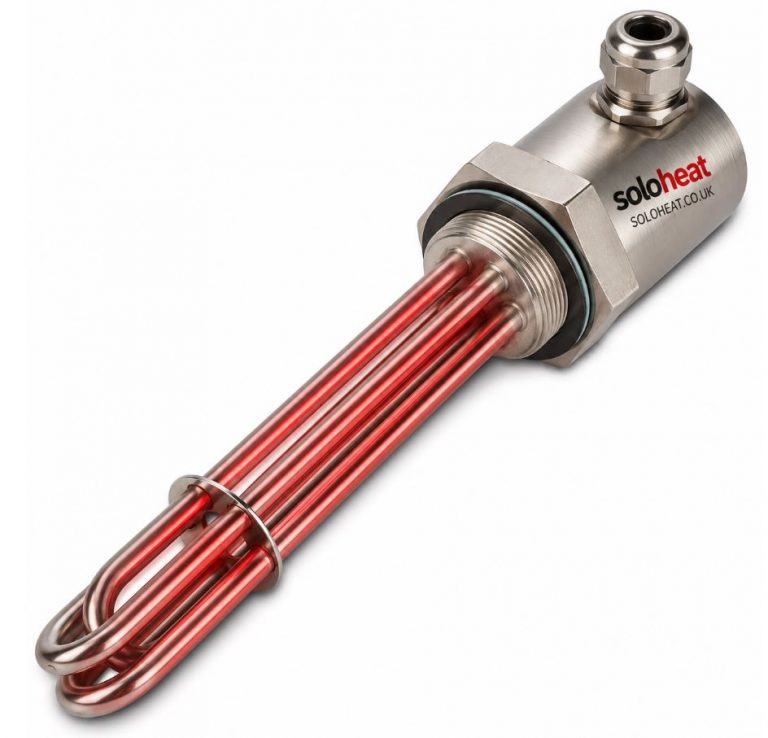
Soloheat has manufactured tubular heating elements since 1980 and maintains an extensive stock of elements in a wide range of sizes, power ratings and voltages.
We can supply straight or formed tubular heating elements to customer requirements, suitable for single-phase and three-phase electrical configurations.
Terminations can be manufactured to customer specifications and may include threaded fittings or bosses, thermocouple and thermostat pockets, terminal enclosures, hard-wired leads and other bespoke arrangements. Single-ended elements are also available where a completely sealed heating element construction is required.
We have an extensive library of CAD drawings and 3D models for previously manufactured elements. Where a bespoke replacement is required, we can also work from customer drawings, dimensions or existing samples to reverse engineer a replacement element.
We can also manufacture 7.5 mm, 5.5 mm and 3.3 mm flat-section elements for applications where increased surface contact and efficient heat transfer are required. These can also be manufactured with integrated thermocouples where required.
What Are Tubular Heaters?
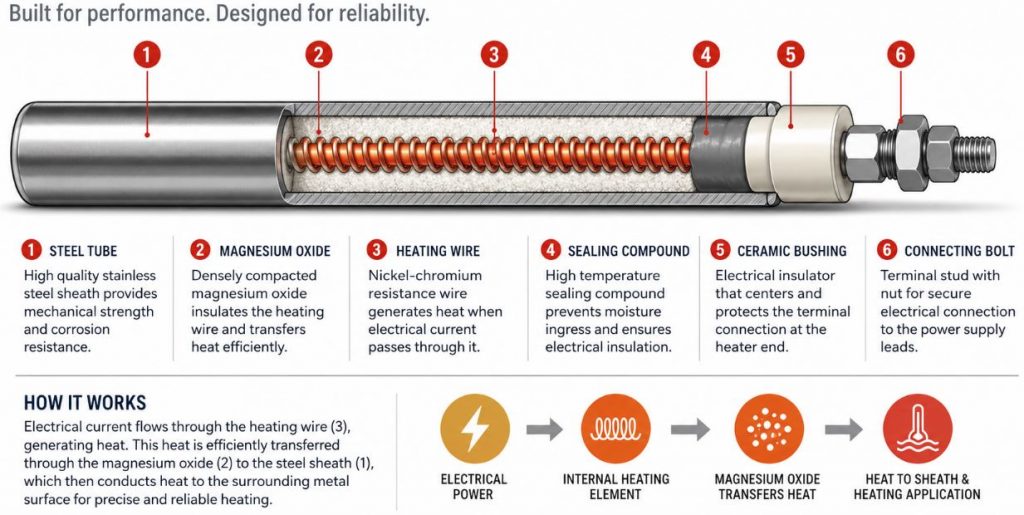
Tubular heaters are among the most versatile and durable industrial heating elements available. They are manufactured with a metal sheath containing a nickel-chromium resistance wire electrically insulated from the sheath by densely compacted magnesium oxide (MgO). This construction provides efficient heat transfer and reliable performance across a wide range of industrial and commercial applications.
Tubular heating elements can be manufactured straight or formed into a wide variety of shapes, making them suitable for air heating, liquid heating, contact heating and custom OEM equipment.
At Soloheat, we manufacture custom tubular heaters to suit individual applications, with a wide range of element diameters, sheath materials, wattages, voltages, formed profiles, mounting arrangements and electrical terminations available.
How Tubular Heating Elements Work
When electrical current passes through the internal nickel-chromium resistance wire, heat is generated and transferred through the densely compacted magnesium oxide (MgO) insulation to the outer metal sheath.
This construction provides good thermal conductivity while maintaining electrical insulation between the resistance wire and metal sheath. The resulting element is mechanically robust and capable of operating at high temperatures when correctly specified for the application.
Depending on the application, tubular heaters can be supplied straight or formed into complex three-dimensional shapes to improve heat transfer, follow the profile of the heated component or fit within confined spaces.
Applications
Tubular heating elements are used throughout industry wherever dependable process heating is required. When correctly specified, they can be used for heating air, water, oils and many other liquids, as well as for direct contact heating.
Typical applications include:
- Ovens
- Duct heaters
- Mould heating
- Commercial catering equipment
- Water tanks & vessels
- Freeze protection
- Washing & drying equipment
- Chemical tanks
- Oil heating
- Plastics machinery
- Packaging machinery
- Food processing equipment
- Pharmaceutical equipment
- Laboratory equipment
- HVAC systems
- Dry-air heating
Technical Specifications Table
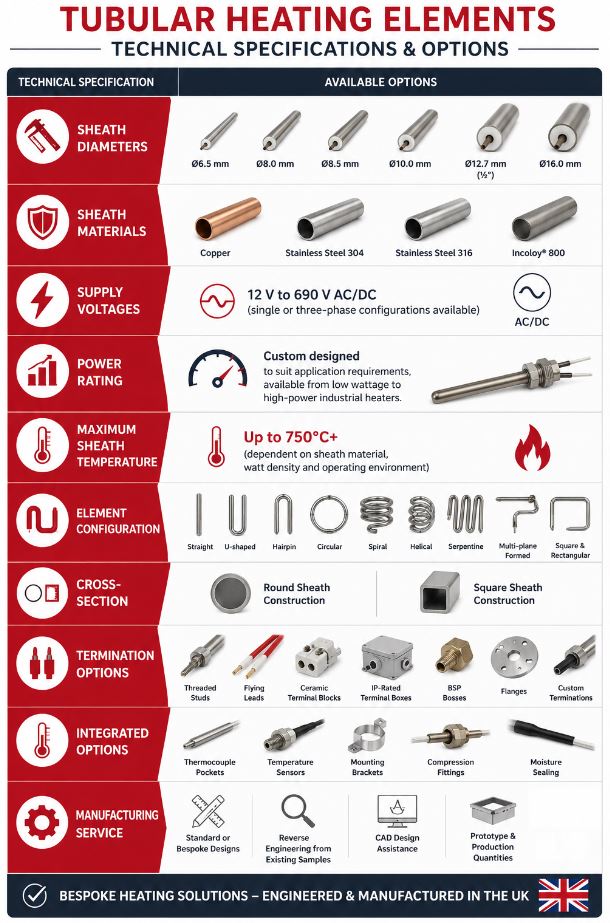
Every tubular heating element is designed specifically for its application. The specifications below illustrate our standard manufacturing capabilities. Alternative diameters, sheath materials, voltages and configurations are available on request to suit individual application requirements.
Available Terminations
We can provide a wide range of termination and mounting arrangements to suit individual applications. Common options include:
- Threaded terminal studs
- Flying leads – hard-wired or detachable
- Terminal blocks
- IP-rated terminal enclosures
- Immersion bosses
- Mounting flanges
- Silicone-insulated leads
- Armoured cable – stainless-steel braid or flexible conduit
Available Heater Forms
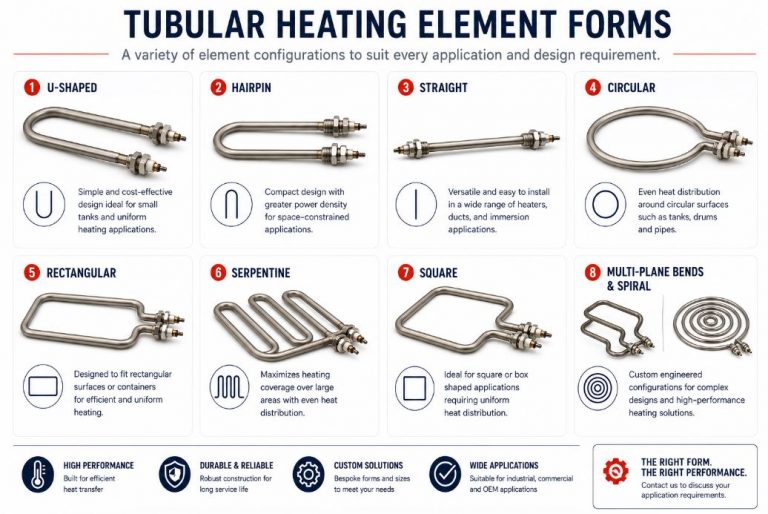
Straight tubular heating elements can be formed into a wide range of profiles to suit individual applications. Common forms include:
- Straight
- U-shaped
- Hairpin – tighter formed than a standard U-shape
- Spiral
- Circular
- Rectangular
- Serpentine
- Square
- Multi-plane bends
Custom-formed elements can also be manufactured from customer drawings, dimensions or existing samples, subject to element diameter and forming requirements.
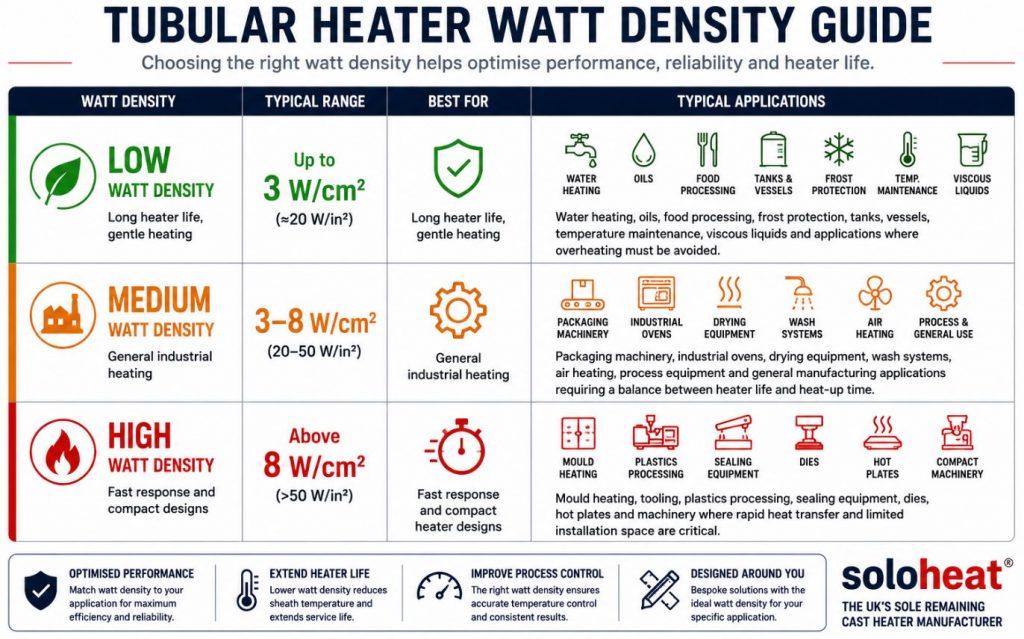
Tubular Heating Element Watt Density Guide
Choosing the correct watt density is important for achieving the required heat-up time, operating temperature and heater service life. Watt density refers to the amount of electrical power generated per unit area of the heater sheath.
Every application is different. Using a watt density that is too high for the application can increase sheath temperature and shorten element life, while a watt density that is too low may result in unnecessarily slow heating or insufficient process temperature.
Our engineers can calculate and recommend a suitable watt density based on factors including the heated medium or material, required process temperature, heat transfer conditions, element construction and installation environment.
Need help selecting the correct heater? Contact Soloheat’s technical team for application advice and a quotation.
Frequently Asked Questions - Tubular & Square Section Elements
What is a tubular heater?
A tubular heater is a versatile electric heating element consisting of a nickel-chromium resistance wire electrically insulated from a metal sheath by densely compacted magnesium oxide (MgO). This construction provides efficient heat transfer, electrical insulation and mechanical strength. Tubular heating elements can be manufactured straight or formed into a wide range of shapes for heating air, liquids or solid components.
What sheath material should I use?
The most suitable sheath material depends on the application, operating temperature and environment. Stainless steel is suitable for many industrial processes and provides good corrosion resistance. Incoloy® alloys are commonly selected for elevated temperatures and demanding environments, while copper is frequently used for water-heating applications. Other sheath materials are also available depending on the application.
What is the maximum operating temperature?
Maximum operating temperature depends on the sheath material, element construction, watt density and application. Correctly specified tubular heating elements can operate at sheath temperatures exceeding 750°C. The appropriate operating limit should always be determined for the particular heater construction and application to provide reliable service life.
Can you copy an existing heater?
Yes. Soloheat regularly manufactures replacement tubular heating elements from customer samples, drawings or dimensions. We can reproduce the principal dimensions, formed profile, electrical ratings, fixing arrangements and terminal configuration, while recommending design changes where appropriate.
What diameter should I choose?
Common tubular heater diameters include 6.5 mm, 8.0 mm, 8.5 mm, 10.0 mm, 12.7 mm and 16 mm. Smaller diameters can be useful where installation space or tighter forming is required, while larger diameters can provide greater mechanical strength and allow different power configurations. The most suitable diameter depends on the application and heater design.
Can tubular heaters be bent?
Yes. Tubular heating elements can be formed into U-shapes, hairpins, coils, spirals and complex three-dimensional profiles to suit tanks, ovens, ducts, machinery and OEM equipment. Bend radii and forming arrangements depend on the element diameter, sheath material and internal construction.
Do you manufacture immersion heaters?
Yes. Soloheat manufactures custom immersion heaters using tubular heating elements fitted with threaded bosses, flanges or other suitable mounting arrangements. These can be designed for heating water, oils, chemicals and other process liquids, with sheath material and watt density selected to suit the heated medium.
Can thermocouples be built in?
Yes. Integral thermocouples can be incorporated into tubular heating elements where local temperature monitoring or closed-loop process control is required. The thermocouple position and construction can be selected to provide temperature feedback appropriate to the heater and application.
What watt density should I specify?
The correct watt density depends on the material or medium being heated, operating temperature, heat transfer conditions, element construction and required heat-up time. Excessive watt density can increase sheath temperature and shorten element life, while insufficient watt density may result in slow heating or inadequate process temperature. Soloheat can calculate and recommend a suitable watt density for your application.
What information do you need for a quotation?
To provide an accurate quotation, we typically require:
- Overall heater dimensions or drawing
- Element diameter and formed shape
- Voltage and wattage
- Sheath material, if known
- Operating temperature
- Heating medium, e.g. air, water, oil, chemical or metal
- Mounting details
- Terminal style and lead configuration
- Quantity required
- Any photographs or existing samples available
If you’re unsure of any of these details, contact our technical team. We can help identify or specify a suitable tubular heating element for your application.

Why Choose Soloheat?
Soloheat combines heating-element manufacturing experience dating back to 1980 with responsive UK-based production to supply high-quality tubular heating elements for a wide range of industrial applications. Heaters can be manufactured to suit individual application requirements, including dimensions, electrical ratings, sheath materials, watt density, formed profile and termination arrangements.
Whether you require a one-off replacement heating element, prototype or volume production for OEM equipment, our experienced team can help specify a suitable design, watt density, sheath material and termination arrangement. We provide fast quotations, technical support and flexible manufacturing to help customers replace existing heaters or develop heating solutions for new applications.
- Manufactured in England
- Heating-element manufacturing experience since 1980
- Fast quotation service
- Bespoke manufacture
- Reverse engineering of existing heaters
- CAD design capability
- Competitive lead times
- OEM supply
- Worldwide export

To Order or Enquire
Download our Tubular Heater Survey Sheet to provide the information required for quotation or manufacture.
Alternatively, email us with your drawing, dimensions, heater specification or existing heater details and we’ll be happy to discuss your requirements.
Please refer to our Terms and Conditions of Business regarding warranty provisions (Section 6).
Soloheat Electric Heating Element Solutions – Quick Links
Not sure this is the right product for your application? Take a look at our other heating solutions:
- Cast Aluminium / Aluminium Bronze Heaters
- Ceramic Band Heaters
- Mica Band Heaters
- Cartridge Heaters
- Nozzle Heaters
- Spiral Wrap Heaters
- Thermocouples, Sensors, Plugs & Cables
- Ancillary Items
- Insulation Jackets
- Heated Hoses

For more information on Electric Engineering Principles, check out our Engineering Guide