Tel +44 (0)1453 752459
or Email

🔥 CARTRIDGE HEATERS
Custom • High Watt Density • UK Stock • Online Store

Thermocouples, Temperature Sensors, Plugs & Cables | UK Manufacturer

Industrial thermocouples provide accurate temperature measurement for process monitoring and control, helping maintain product quality, improve process efficiency and protect equipment. Soloheat supplies a comprehensive range of thermocouples, PT100 resistance temperature sensors, thermocouple plugs, compensating cables and associated accessories for a wide range of industrial heating applications.

Whether you require a standard replacement sensor or a bespoke assembly manufactured to your specification, our experienced team can provide technical advice and fast quotations. We supply individual components through to complete temperature-sensing solutions for plastics processing, packaging machinery, food production, laboratory equipment, heat-treatment systems and many other industrial processes.

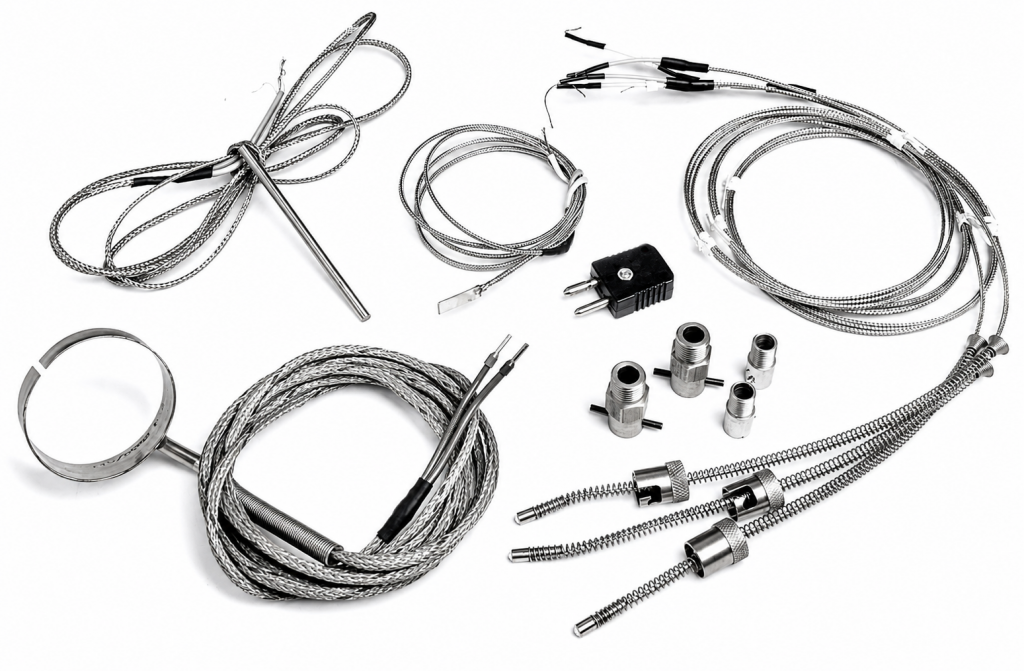
Soloheat thermocouple and sensors

Need Thermocouples & Ancillaries Quickly?

We stock a growing range of commonly selected thermocouples and associated items, available to purchase online with live pricing.

✔ Standard thermocouple types

✔ Popular plugs & connectors

✔ High-quality industrial cables & ancillary items

Browse our Online Thermocouples, Plugs & Cables Store →

How Thermocouples Work

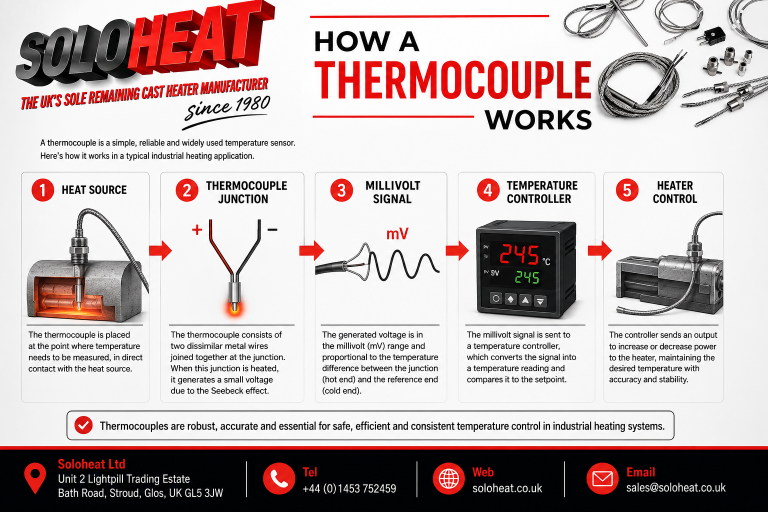
A thermocouple measures temperature using two dissimilar metal conductors joined together at one end to form a measuring junction. When the temperature of this junction differs from the reference junction, a small electrical voltage is generated. This voltage varies with the temperature difference between the two junctions.

A suitable temperature controller or measuring instrument interprets this voltage, typically using cold-junction compensation, to determine the process temperature. Where used for temperature control, the controller can regulate heaters by switching electrical power or using PID control to maintain the required operating temperature.

Thermocouples are widely used in industrial applications because they are robust, fast responding and capable of measuring over a wide range of temperatures, depending on thermocouple type and construction.

How A Thermocouple Works infographic

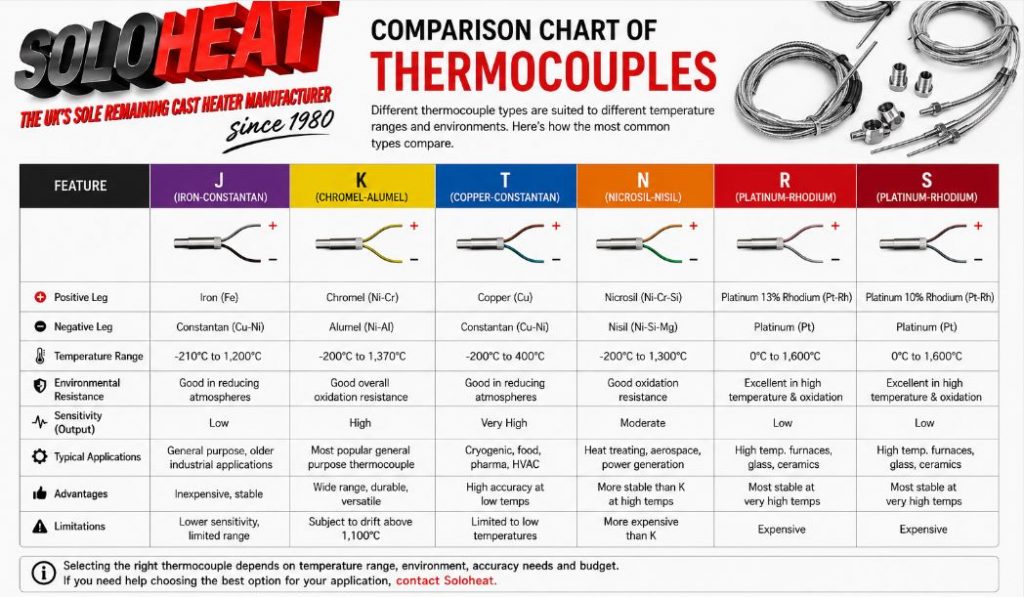
Thermocouple Types

Soloheat supplies a wide selection of thermocouple types suitable for industrial temperature measurement and control. The most appropriate type depends on the required temperature range, atmosphere, accuracy and application.

Type J

Iron/Constantan thermocouples are commonly used for general industrial temperature measurement, including plastics processing machinery and moderate-temperature applications.

Type K

Nickel-Chromium/Nickel-Aluminium thermocouples are among the most widely used industrial thermocouple types. Type K offers a broad temperature range and is suitable for many general industrial heating applications.

Type T

Copper/Constantan thermocouples are particularly suited to lower-temperature measurement and applications where good stability at lower temperatures is required.

Type N

Nicrosil/Nisil thermocouples offer good stability at elevated temperatures and can be suitable for demanding high-temperature industrial applications.

Type R & Type S

Platinum-based precious-metal thermocouples are used for high-temperature measurement, including furnace, heat-treatment and laboratory applications.

If you are replacing an existing sensor, our team can help identify the correct thermocouple type from a sample, drawing or machine specification.

Grounded vs Ungrounded Thermocouple Junctions
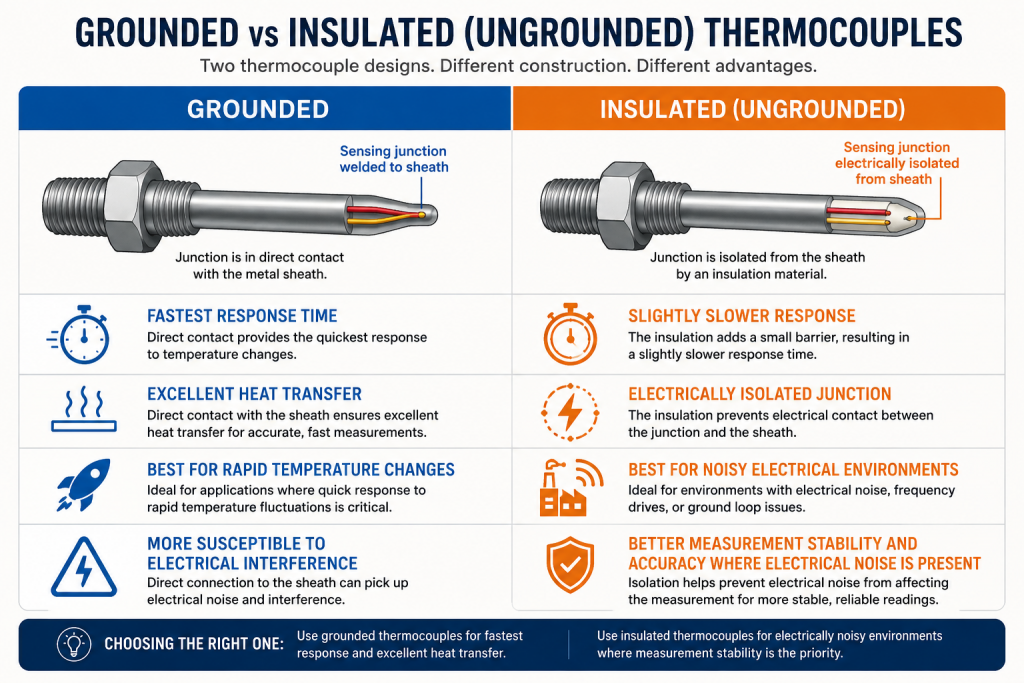
Grounded vs ungrounded thermocouple junctions

Grounded Thermocouples

A grounded thermocouple has its measuring junction electrically connected to the metal sheath. This generally provides a faster response to temperature changes because of the direct thermal connection between the junction and sheath. However, the electrical connection to the sheath can make a grounded sensor less suitable where electrical isolation is required or where ground-loop interference may occur.

Ungrounded (Insulated) Thermocouples

An ungrounded thermocouple has its measuring junction electrically isolated from the metal sheath. This provides electrical isolation and can help reduce problems associated with ground loops and electrical interference. The additional insulation generally results in a slower response compared with an equivalent grounded junction.

Available Sensor Styles

Every application requires a different sensing arrangement. Soloheat supplies thermocouples and temperature sensors in a wide range of configurations, including:

  • Bayonet thermocouples
  • Mineral-insulated thermocouples
  • Surface sensors
  • Ring-terminal sensors
  • Washer thermocouples
  • Bolt-on sensors
  • Compression-fitting thermocouples
  • Heavy-duty industrial probes
  • Needle probes
  • Flexible cable sensors
  • Custom-fabricated assemblies

Soloheat thermocouple and temperature sensor types

Sensors can be manufactured with a variety of probe diameters, insertion lengths, spring assemblies, mounting fittings and cable terminations to suit both new equipment and replacement installations.

Available Materials

The choice of sheath and cable materials can have a significant effect on sensor performance and service life.

Common sheath materials include:

  • Stainless steel
  • Inconel
  • Mild steel
  • Brass
  • Ceramic

Cable and lead protection options include:

  • Glass-fibre insulation
  • Stainless-steel braided protection
  • PTFE insulation
  • Silicone insulation
  • PVC insulation
  • Mineral-insulated constructions

The correct material and construction depend on factors including operating temperature, chemical exposure, moisture, required mechanical protection and flexibility. Our technical team can help recommend a suitable construction for your application.

Thermocouple Plugs

Correct thermocouple connectors are important for maintaining measurement accuracy and the correct thermoelectric circuit.

Soloheat supplies standard and miniature thermocouple plugs and sockets for a variety of thermocouple types, allowing connection to compatible temperature controllers and instrumentation.

Available options include:

  • Standard plugs
  • Miniature plugs
  • Panel sockets
  • Inline connectors
  • Male and female connectors
  • Colour-coded connectors to recognised thermocouple standards
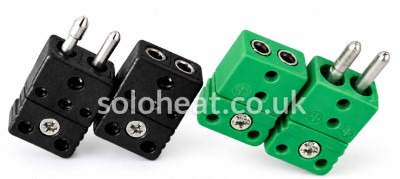
Standard Type J and Type K thermocouple plugs

Thermocouple connectors are manufactured using connector materials appropriate to the thermocouple type, helping maintain the correct thermoelectric characteristics through the connection.

Thermocouple plugs are available to purchase from our online store at the bottom of this page.
Compensating Cables

Thermocouple extension and compensating cables allow thermocouple signals to be carried from the sensor to a remote temperature controller or measuring instrument. Correct cable type and polarity are important for maintaining measurement accuracy.

Available cable constructions include:

  • PVC-insulated cable
  • Silicone-insulated cable
  • PTFE-insulated cable
  • Glass-fibre-insulated cable
  • Stainless-steel braided protection
  • Multi-core cable
  • High-temperature cable

Extension or compensating cable should be selected to suit the thermocouple type, operating environment, temperature and required mechanical protection. Our technical team can help specify a suitable cable for your application.

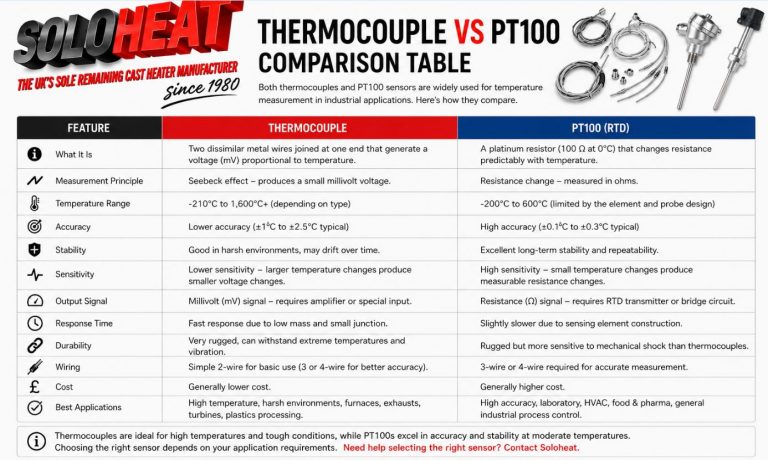
PT100 Sensors

Thermocouple vs PT100 Infographic

PT100 resistance temperature detectors (RTDs) provide accurate, repeatable temperature measurement and good long-term stability.

Unlike thermocouples, PT100 sensors operate by measuring changes in electrical resistance rather than generating a thermoelectric voltage.

They are widely used where measurement accuracy, repeatability and long-term stability are important and where the application does not require the higher temperature capability available from some thermocouple types.

Soloheat supplies PT100 sensors in a wide variety of probe styles and constructions suitable for industrial machinery and process-control applications. See the comparison chart below for further information, or contact us to discuss your application.

Bespoke Temperature Control Units

Complete Temperature Control Solutions – Designed and Built by Soloheat

At Soloheat, we don’t just supply thermocouples and temperature sensors. We can also design and manufacture bespoke temperature control units for industrial heating applications.

From a simple single-zone portable controller to a multi-loop temperature control system integrated into your machinery, we can build a solution around your application requirements.

Control units can be supplied as portable units, bench-top enclosures, panel-mounted systems or integrated into your machinery.

Fully Bespoke Temperature Control

Every application is different, so our temperature control systems can be configured to suit requirements including:

  • Number of temperature-control loops
  • Heater voltage
  • Heater power rating
  • Number and type of heater outputs
  • Thermocouple or temperature-sensor type
  • Required temperature range
  • Control method
  • Enclosure and mounting requirements
  • Electrical connections
  • Isolation and protection requirements

Whether you require control for one heater or multiple independent heating zones, we can design the system to suit the application.

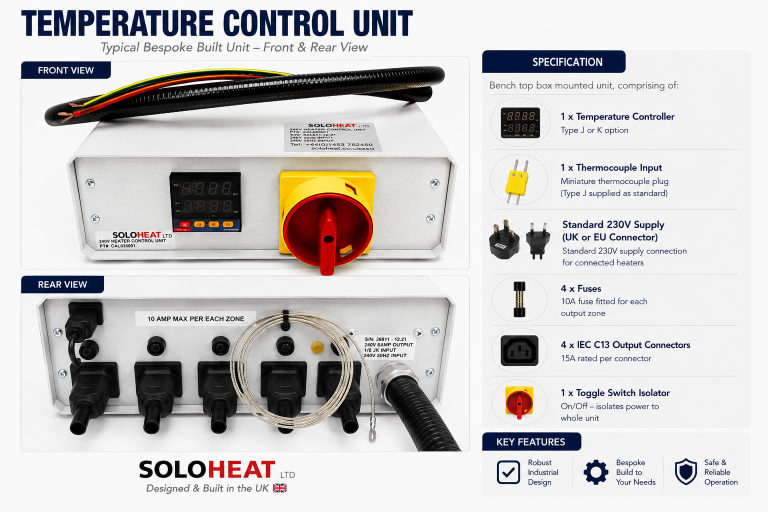
Soloheat Temperature Control Unit

From initial specification through to the finished control unit, Soloheat can provide a complete bespoke build service.

We can help specify and integrate the complete control arrangement:

Temperature Sensor → Temperature Controller → Electrical Protection → Heater Outputs → Enclosure → Machine Integration

This allows the temperature sensing and heating-control requirements to be considered together rather than sourcing individual components from different suppliers.

Need a Bespoke Temperature Control Unit?

If you have an industrial heating application requiring temperature sensing, control and heater outputs in one complete system, talk to Soloheat.

Send us your requirements, drawings or existing machine details and we can discuss a suitable control solution.

Useful information to provide includes:

  • Number of heating zones
  • Heater voltage
  • Heater wattage
  • Required temperature range
  • Thermocouple or temperature-sensor type
  • Preferred mounting arrangement
  • Number of heaters
  • Details of any existing machinery or control equipment

We can then develop a bespoke temperature control solution to suit your application.

Why Choose Soloheat?

Since 1980, Soloheat has supplied industrial electric heating and temperature-sensing solutions to customers throughout the UK and overseas.

Why choose Soloheat?

  • Industrial heating experience since 1980
  • Fast quotation service
  • Standard and bespoke temperature sensors
  • Technical support for sensor selection and specification
  • Small or large production quantities
  • Replacement sensors manufactured to samples, drawings or specifications
  • Thermocouples, PT100 sensors, plugs, cables and associated accessories
  • Bespoke temperature-control solutions

Whether you require a single replacement thermocouple or an ongoing production supply, Soloheat can help specify and supply a temperature-sensing solution to suit your application.

To Order or Enquire

Download our Thermocouple Survey Sheet to provide the information required for quotation or manufacture.

Alternatively, email us with as much of the following information as possible to help us recommend or manufacture the correct temperature sensor:

  • Thermocouple or sensor type and required temperature range
  • Probe diameter
  • Probe length
  • Probe-tip profile, e.g. flat, rounded or pointed
  • Grounded or ungrounded (insulated) junction, if applicable
  • Spring outside diameter (OD) and length
  • Bayonet cap inside diameter (ID) and length
  • Lead type and length, e.g. 1500 mm stainless-steel braided
  • Special fittings, plugs or termination details
  • Quantity required
  • Required delivery date

If you are unsure of any part of the specification, send us a photograph, technical drawing or an existing sample. Our team can help identify a suitable replacement. Alternatively, contact us to discuss your application.

Frequently Asked Questions – Thermocouples

What is the difference between Type J and Type K thermocouples?

Type K thermocouples offer a broader temperature range and are widely used for general industrial temperature measurement. Type J thermocouples are commonly used in plastics processing machinery and moderate-temperature industrial applications. The most suitable type depends on the required temperature range, atmosphere and application.

Can Soloheat manufacture custom thermocouples?

Yes. We can manufacture bespoke temperature sensors to customer drawings, specifications or existing samples.

How do I identify my existing thermocouple?

Send us a photograph, drawing or existing sensor and we can help identify the thermocouple type, dimensions, mounting arrangement and connection details.

Do I need extension or compensating cable?

If the thermocouple connection needs to be extended to a remote controller or measuring instrument, the correct extension or compensating cable should be used for the thermocouple type. Correct cable type and polarity are important for maintaining measurement accuracy.

Can you supply matching plugs and sockets?

Yes. We supply standard and miniature thermocouple plugs and sockets for a range of thermocouple types.

How do I choose the correct thermocouple for my application?

The correct thermocouple depends on factors including operating temperature, installation method, environmental conditions, response requirements and required accuracy. If you’re unsure, send us a drawing, photograph or existing sample and we can help specify a suitable sensor.

What is the difference between grounded and ungrounded thermocouples?

A grounded thermocouple has its measuring junction electrically connected to the metal sheath, generally providing a faster response to temperature changes. An ungrounded thermocouple has its measuring junction electrically isolated from the sheath, providing electrical isolation and helping reduce problems associated with ground loops and electrical interference.

Why has my thermocouple stopped working?

Possible causes include excessive temperature, vibration, cable or connection damage, moisture ingress, corrosion, mechanical damage or deterioration of the sensing element over time. The cause should be identified before replacing the sensor, particularly where repeated failures occur.

Soloheat Electric Heating Element Solutions – Quick Links

Not sure this is the right product for your application? Take a look at our other heating solutions:

Engineering guide thumbnail

For more information on Electric Engineering Principles, check out our Engineering Guide

Online store - Thermocouples, Plugs, cables & fittings

Click here to e-mail us

Click here for other contacts

In a hurry? Complete our contact form and we will get back to you ASAP – click here

© 2026 Soloheat Ltd. All rights reserved.