Cartridge Heaters UK – Custom Manufacturer & Stock Heaters
Soloheat is a UK cartridge heater manufacturer supplying custom and stock cartridge heaters for plastics processing, machinery, tooling and industrial heating applications. Bespoke cartridge heaters are manufactured in the UK to customer drawings, samples or specifications, with a growing range of standard sizes available for fast UK dispatch.
Need a standard cartridge heater quickly?
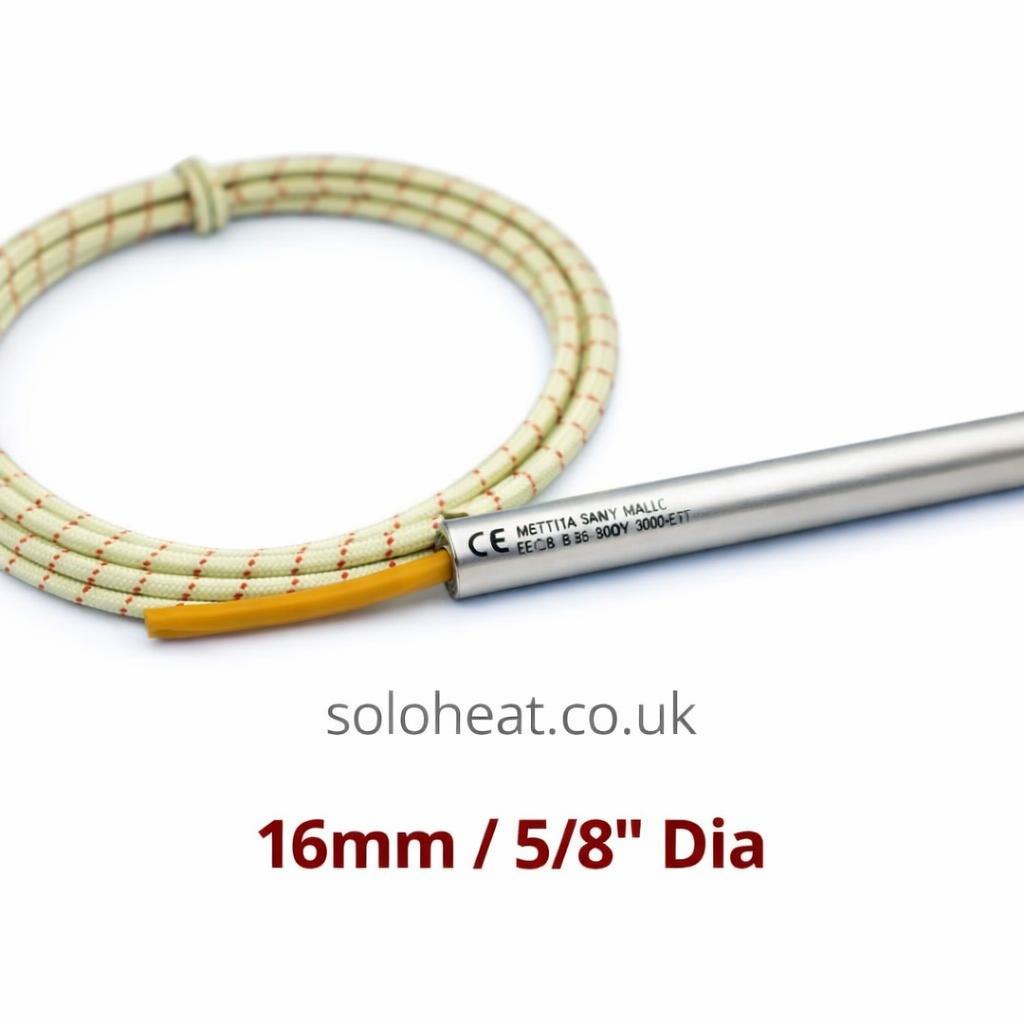
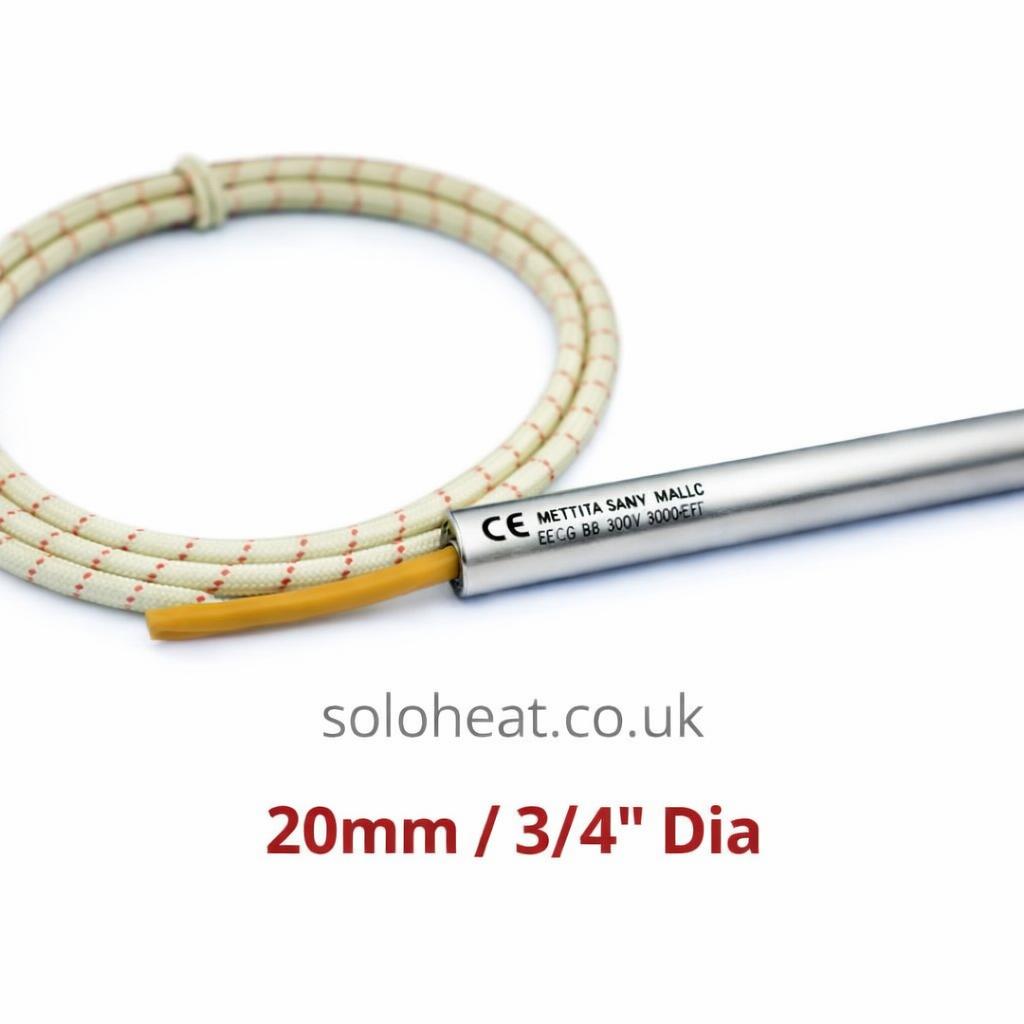
We stock a growing range of standard cartridge heaters available to purchase online with live pricing and fast UK dispatch.
✔ Standard diameters
✔ Popular wattages
✔ Fast UK dispatch
Soloheat Electric Cartridge Heaters are supplied to OEM machine builders, maintenance contractors and end users worldwide. We manufacture from customer drawings, survey sheets, sketches or existing samples and can advise on the most suitable heater design for both replacement and new-build applications.
Cartridge Heater Features
- High-density cartridge heaters
- Medium-density cartridge heaters
- Low-density cartridge heaters
- Swaged cartridge heaters
- Mineral-insulated cartridge heaters
- Metric cartridge heaters
- Imperial cartridge heaters
- Miniature cartridge heaters
- Integrated thermocouple cartridge heaters
- Stainless steel cartridge heaters
- Incoloy cartridge heaters
- Corrosion-resistant cartridge heaters
- Bespoke cartridge heaters
- Maximum application temperature: up to 700°C (1292°F), depending on cartridge heater construction and application.
Cartridge Heater Watt Densities & Maximum Available Lengths
Cartridge heaters are available in three principal watt-density constructions. The appropriate construction depends on the required power, heater dimensions, operating temperature and heat-transfer conditions.
| Construction | Maximum Watt Density | Maximum Length | Maximum Sheath Temperature |
|---|---|---|---|
| Low Watt Density (LW) | 5 W/cm² | 6000 mm | 500°C |
| Medium Watt Density (MW) | 15 W/cm² | 6000 mm | 700°C |
| High Watt Density (HW) | 35 W/cm² | 2500 mm | 700°C |
Maximum values are subject to heater diameter, wattage, construction and application requirements. The optimum watt density should always be selected according to the operating conditions rather than simply specifying the highest available rating.
Minimum Cartridge Heater Dimensions
| Diameter | Minimum Length |
|---|---|
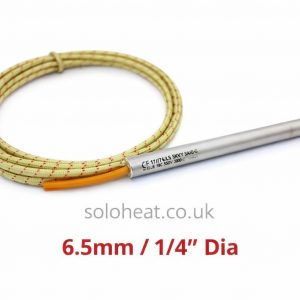
| 6 mm / ¼″ | 32 mm |
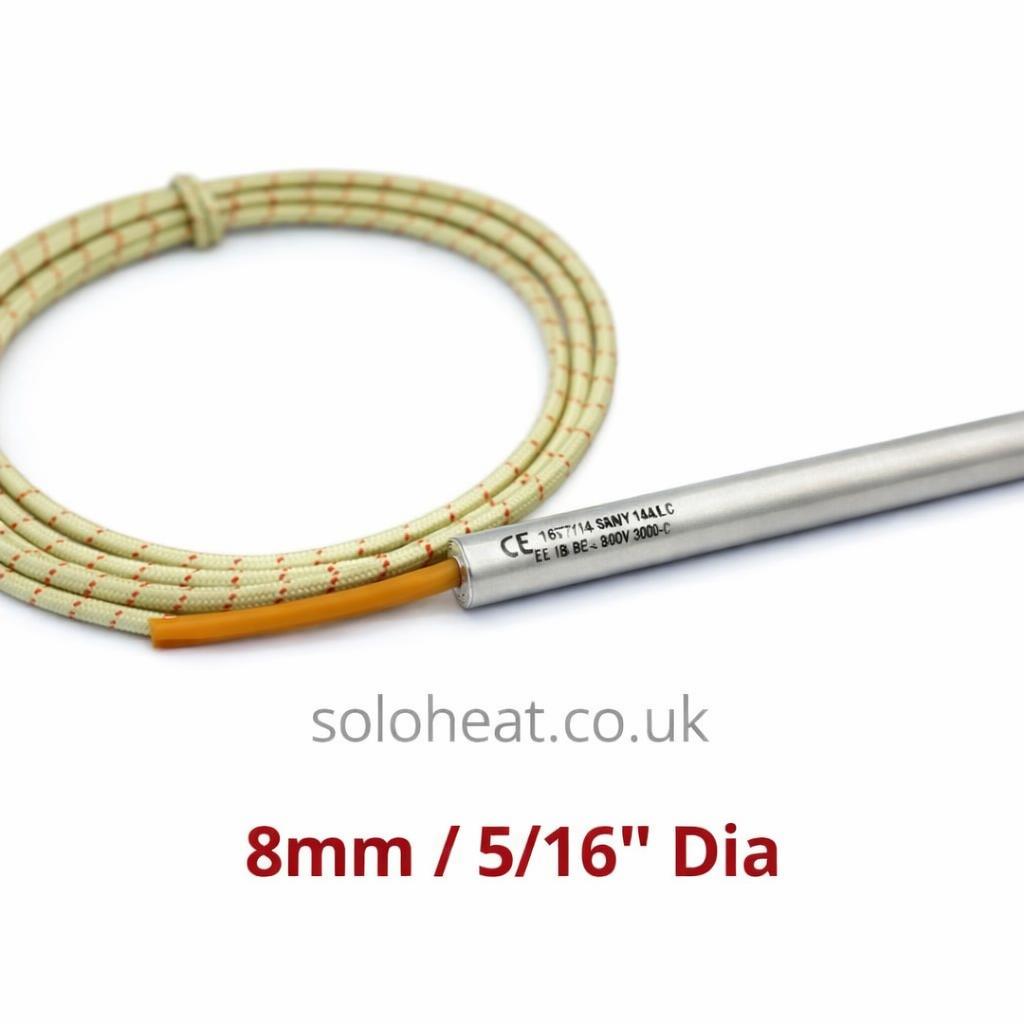
| 8 mm / 5/16″ | 38 mm |
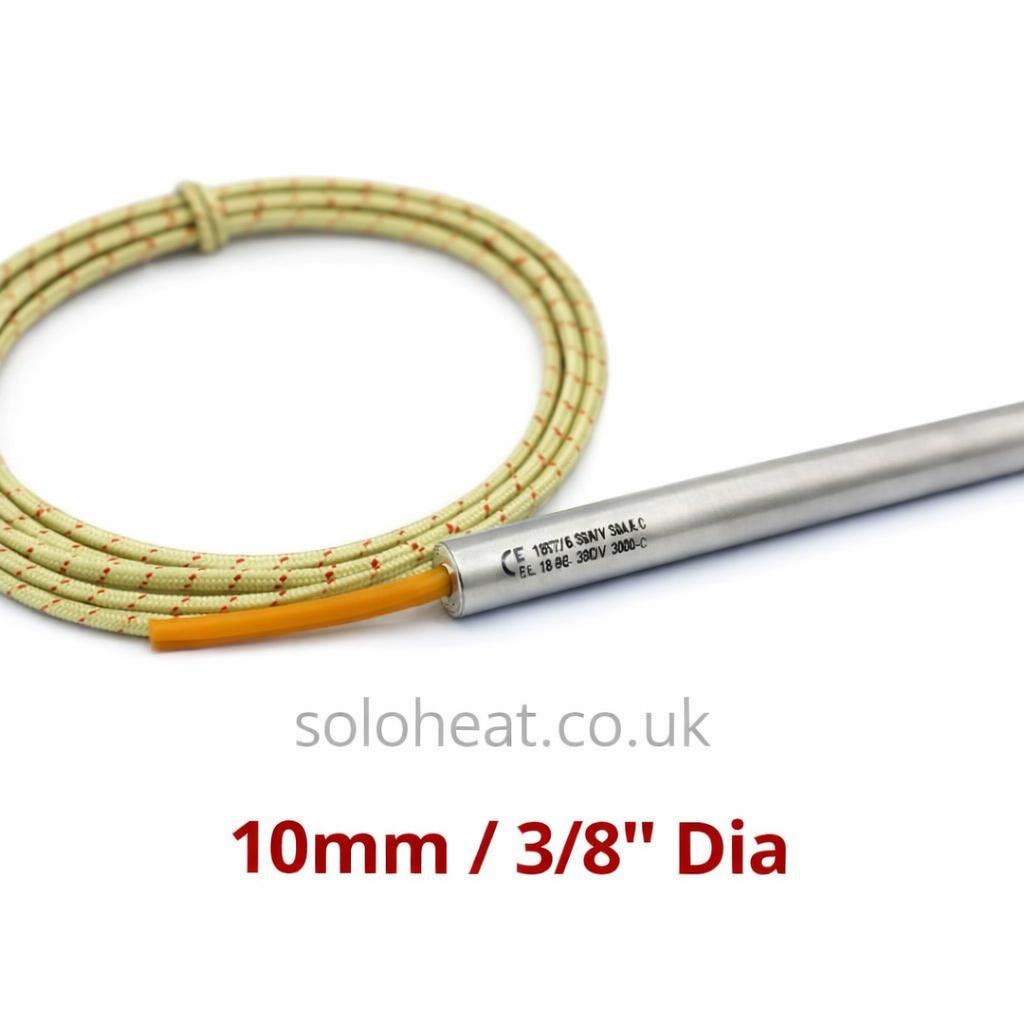
| 10 mm / 3/8″ | 38 mm |
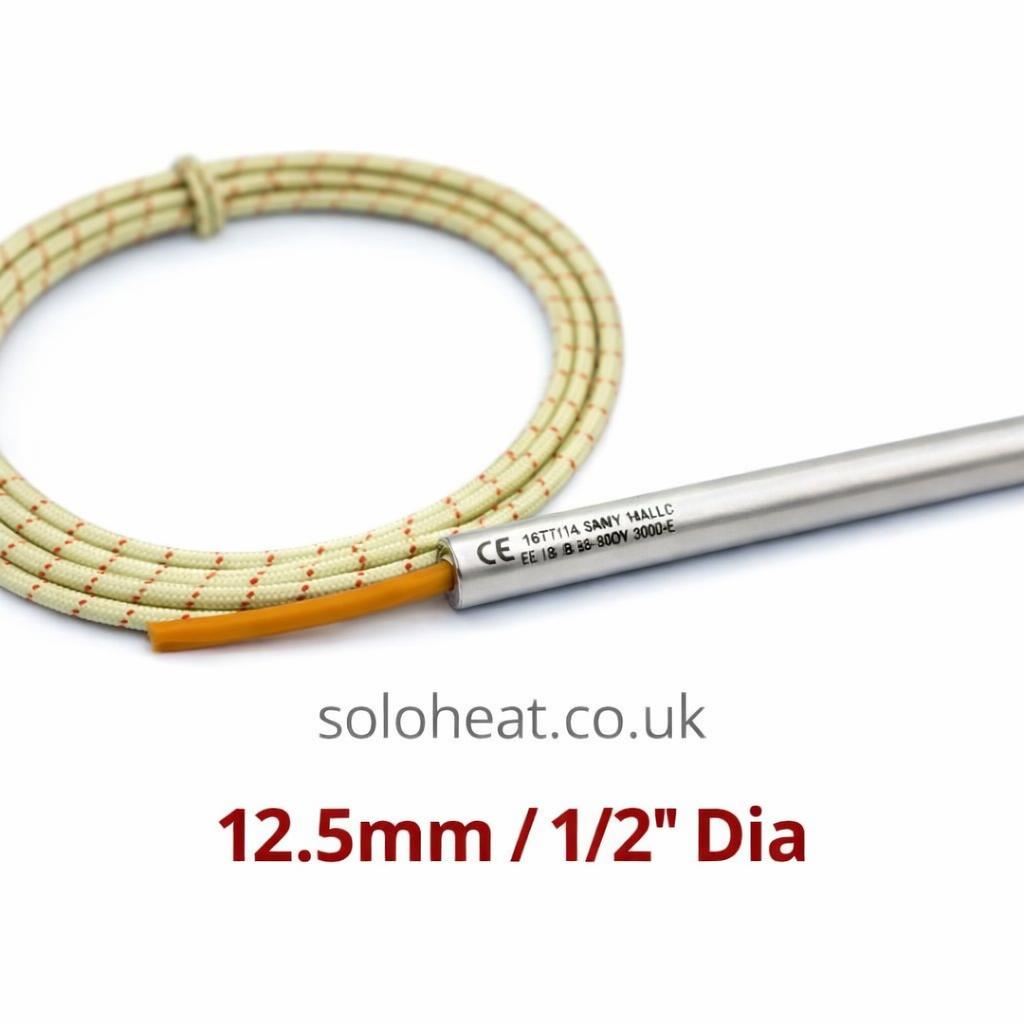
| 12 mm / ½″ | 50 mm |
| 14 mm / 9/16″ | 50 mm |
| 16 mm / 5/8″ | 50 mm |
| 20 mm / ¾″ | 75 mm |
| 25 mm / 1″ | 100 mm |
Minimum dimensions are indicative and may vary according to wattage, voltage, termination and heater construction.
Cartridge Heater Applications
Soloheat cartridge heating elements are used across a wide range of industrial heating applications, including mould tools, extrusion tooling, presses and platens, aerospace and power-generation components, packaging machinery, heat-sealing equipment, food-processing machinery, catering equipment, printing and hot-foil printing machinery, and laboratory and test equipment.
Available in low-, medium- and high-watt-density constructions, cartridge heaters are particularly suitable for applications where installation space is limited and efficient heat transfer into a solid component is required. Heaters can also incorporate thermocouples, retaining plates or washers, threaded bushes and angled elbows to suit the installation.
- Mould heating
- Die heating
- Tool heating
- Hot plates and platens
- Packaging machinery
- Plastics processing machinery
- Injection moulding equipment
- Manifold heating
- Heat-sealing equipment
- Aerospace components
- Medical and pharmaceutical equipment
- Food-processing machinery
- Rubber-processing equipment
- Motorsport applications
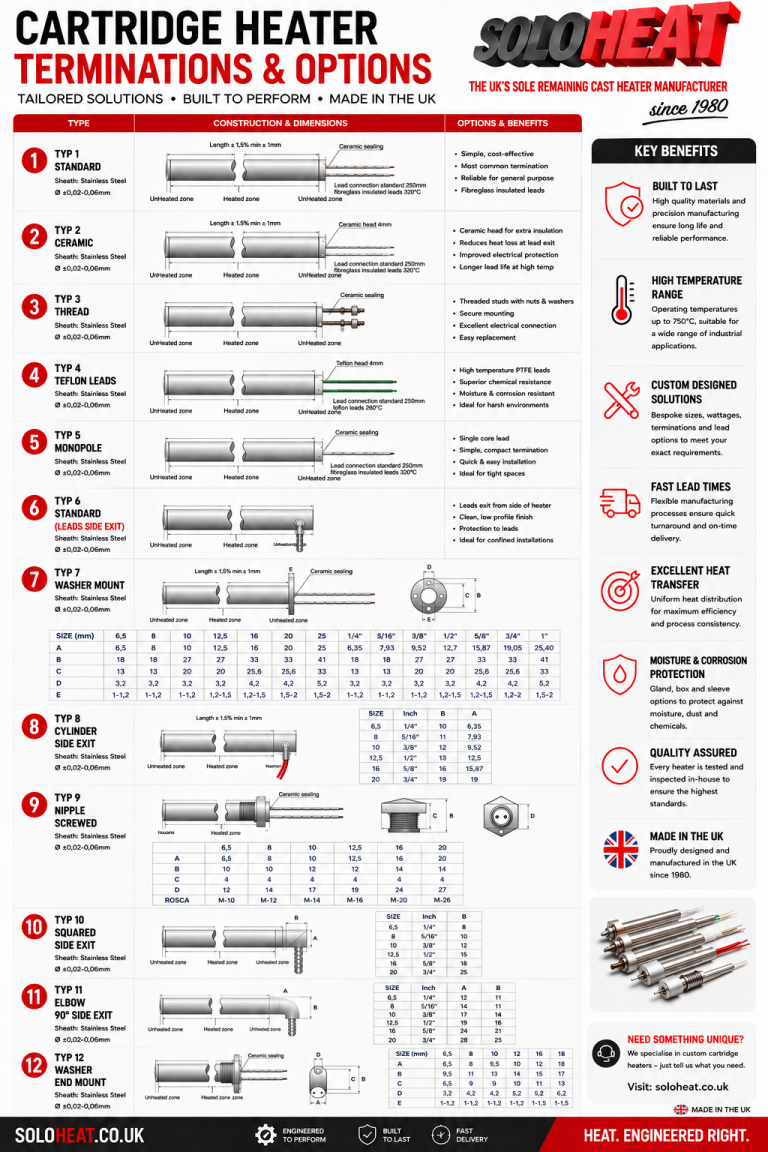
Cartridge Heater Termination Types
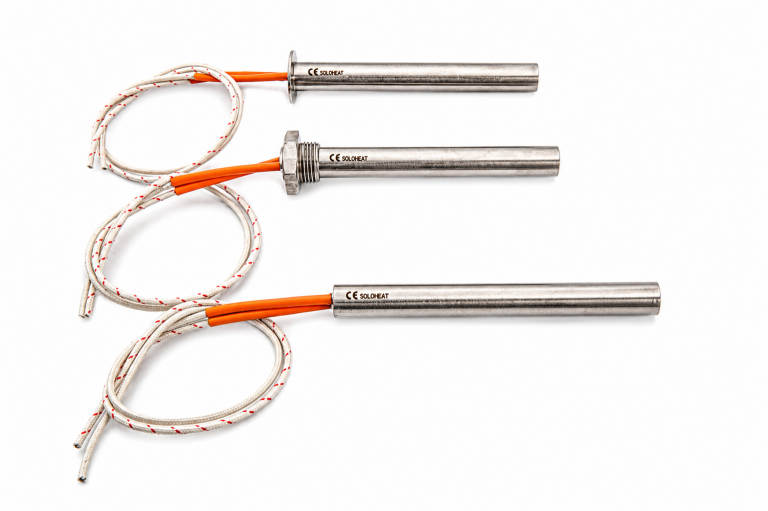
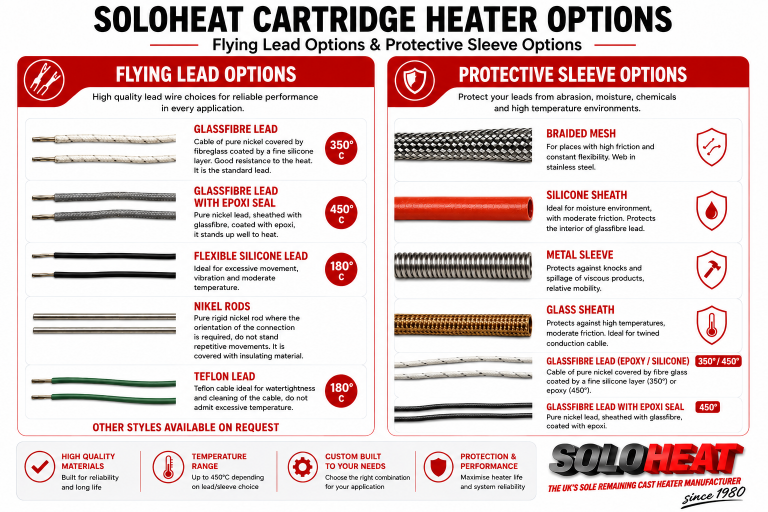
Cartridge heaters (also known as rod heaters) can be supplied with a wide range of electrical terminations to suit the application. Common options include plain fibreglass-insulated leads, stainless-steel braided leads, PTFE-insulated leads and armoured conduit. Plain nickel pins and threaded terminal connections are also available.
Further termination arrangements can be manufactured to suit customer requirements. See below for examples of some of the more common cartridge heater termination types we offer.
Build Options
Every application has different space constraints, electrical connections and environmental requirements. Soloheat offers a wide range of cartridge heater termination and mounting options, allowing each heater to be tailored to the equipment for reliable operation, straightforward installation and long service life.
Our most common build options are shown below, with further bespoke designs available to suit individual applications.
Whether you require a simple lead exit or a sealed, threaded or flange-mounted design, we can manufacture cartridge heaters to suit your application and specification.
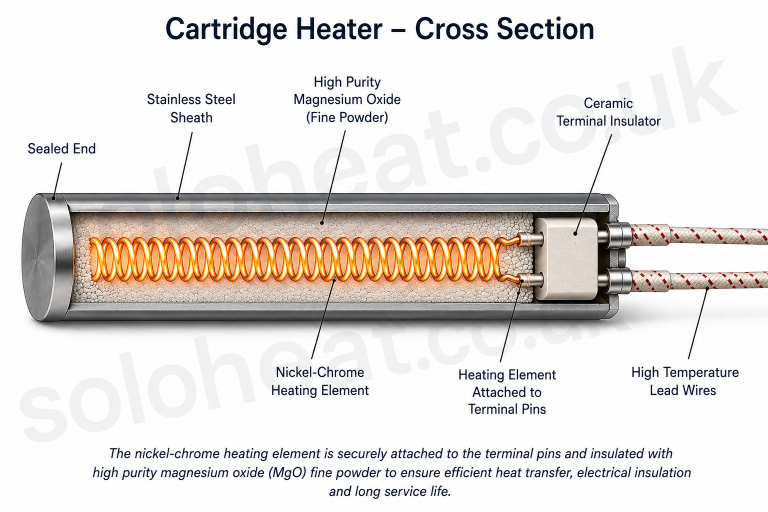
How Cartridge heaters work
Our precision cartridge heating elements consist of a nickel-chromium resistance coil embedded within highly compacted magnesium oxide insulation and enclosed in a precision-ground stainless steel sheath. The compacted insulation provides excellent electrical insulation while efficiently transferring heat from the resistance wire to the outer sheath. When installed into a close-tolerance bore, heat is transferred rapidly into the surrounding metal, providing accurate and uniform process heating.
As standard, cartridge heaters are manufactured with evenly distributed power. Where required, we can manufacture heaters with specially designed internal windings to provide gradual, inactive or variable-wattage zones along the heater length.
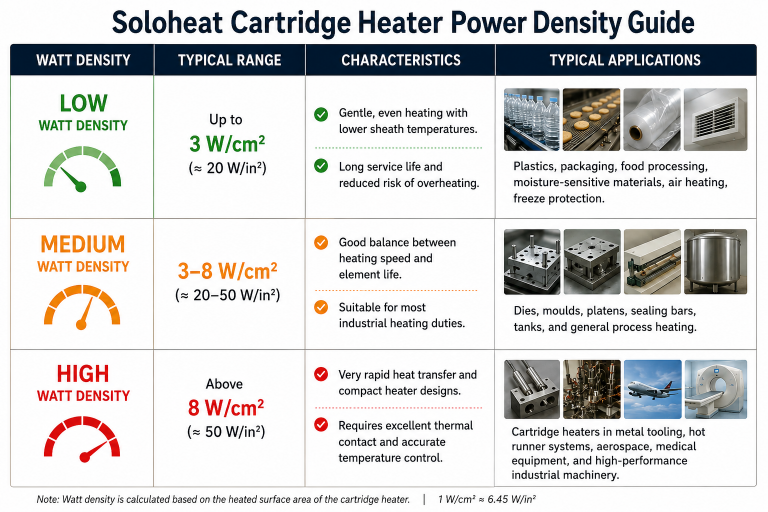
Cartridge Heater Power Density
In industrial electric heating, Watt density is the amount of power applied to a given surface area of the heating element. It is typically expressed as W/cm² or W/in². Higher watt density means more heat is generated from a smaller surface area, resulting in faster heat-up but higher element temperatures.
Here’s how the three categories are generally defined:
Low Watt Density
- Generally operates at a lower sheath temperature for a given application.
- Can help reduce scaling, carbonisation and localised overheating.
- Suitable where the heated material is heat-sensitive or where heat transfer is limited.
- Lower element loading can contribute to longer heater service life when correctly applied.
Medium Watt Density
- Commonly used for a wide range of industrial heating applications.
- Provides a practical balance between available power, heat-up time and element loading.
- Suitable where good heat transfer is available without requiring very high power from a compact heater.
High Watt Density
- Provides high power output from a relatively small heater.
- Can provide faster heat-up where the application can effectively absorb the available heat.
- Requires close contact between the heater and the heated component to transfer heat efficiently and minimise the risk of localised overheating.
- Typically requires accurately machined bores and appropriate temperature control.
Choosing the Right Watt Density
The correct watt density depends on several factors:
- Material being heated – the thermal conductivity and temperature sensitivity of the material affect how readily heat can be transferred away from the heater.
- Heat-transfer efficiency – close contact and efficient heat transfer can permit higher watt densities.
- Required heat-up time – applications requiring rapid heating may require greater installed power, subject to the heat-transfer conditions.
- Operating temperature – heater construction, sheath temperature and process temperature must all be considered when selecting watt density.
- Expected service life – excessive watt density or poor heat transfer can increase element temperature and reduce heater life.
General Guide
- Low watt density – suited to gentler heating and applications with limited heat transfer.
- Medium watt density – suitable for a broad range of general industrial heating applications.
- High watt density – provides high power from a compact heater where efficient heat transfer and appropriate temperature control are available.
Please note that these descriptions are general guidelines rather than fixed application rules. The optimum watt density should be selected according to the required power, heater dimensions, operating temperature, material properties, heat-transfer conditions and installation.
Cartridge Heater Bore Hole Guidance
For optimum performance, cartridge heaters should be installed in precision-machined bores with the correct clearance. Excessive clearance creates air gaps that reduce heat transfer, resulting in higher sheath temperatures and shorter heater life.
A suitable heat transfer paste may be used as a quick fix for air gaps, although re-boring and fitting a slightly larger heater is the best option if possible. We can also centreless grind heaters to ensure a more precise fit should re-boring not be viable.
Cartridge Heater Installation Guide – Correct Fit & Bore Size
Correct cartridge heater installation is essential for efficient heat transfer and long service life. The heater should be installed in a clean, accurately machined bore with a close sliding fit to minimise air gaps and prevent excessive sheath temperature.
For more detailed information on bore tolerances and heater fit, see our Cartridge Heater Fit & Bore Explained guide.
- Ensure the bore is clean and accurately machined. A close fit between the heater and the bore is important for efficient heat transfer. Remove dirt, oil and debris before installation.
- Use the correct bore size. An oversized bore creates air gaps, reducing heat transfer and potentially causing excessive heater sheath temperatures.
- Insert carefully. Push the heater fully into position without excessive force. Never hammer the heater into the bore or apply force to the electrical leads or termination.
- Support and protect the leads. Ensure lead wires are protected from abrasion, sharp edges, excessive movement and temperatures above their rated limit. Provide suitable strain relief where required.
- Protect the lead exit. Where possible, keep the electrical termination and lead exit outside the heated zone. Do not insert the heater beyond its intended heated or sheath length.
- Use suitable temperature control. Operate the heater with an appropriate temperature-control system and correctly positioned temperature sensor to maintain the required process temperature and help prevent overheating.
- Plan for future removal. Where practical, incorporate a suitable means of extracting the heater for maintenance or replacement. Extraction points, threaded removal features or other suitable arrangements can make removal considerably easier, particularly after prolonged service.
Safety Notes
- Disconnect and isolate the electrical supply before installation or maintenance.
- Verify that the supply voltage matches the heater rating.
- Ensure electrical connections and protective measures comply with the applicable electrical requirements for the installation.
- Do not operate a cartridge heater in free air unless it has been specifically designed and rated for that purpose.
- Inspect the heater, leads and termination for damage before installation and do not use damaged components.
Following these guidelines will help promote efficient heat transfer, reliable operation and long cartridge heater service life.
Cartridge Heater Lead Times
We stock a growing range of standard cartridge heaters available to purchase from our online store at the bottom of this page.
Typical manufacturing lead time for bespoke cartridge heaters is 7–10 working days. Premium express manufacturing services may also be available, subject to capacity:
48-hour despatch service: standard manufacturing cost +100% premium
5–7 working day despatch service: standard manufacturing cost +50% premium
Manufacturing lead times and availability of express services are confirmed at the time of quotation.
Order or Enquire
Click here to download our Cartridge Heater Survey Sheet template.
Alternatively, email us with as much of the following information as possible:
- Diameter
- Overall length
- Wattage
- Voltage
- Termination type, lead length and lead protection, where applicable
- Retaining tab, threaded fixing bush or location flange, including dimensions where applicable
- Integrated thermocouple requirement, including thermocouple type and whether a grounded or insulated junction is required
- Heater application
- Quantity required
- Required delivery date
Cartridge Heater Warranty
Please refer to Section 6 of our Terms and Conditions of Business regarding warranty.
Why Choose Soloheat Cartridge Heaters?
Since 1980, Soloheat has manufactured industrial heating elements for OEM machine builders, maintenance contractors and end users throughout the UK and worldwide. Our custom cartridge heaters are manufactured to customer specification, whether from a drawing, survey sheet or existing sample. Contact us to discuss your cartridge heater requirements.
Cartridge Heater FAQs
How tight should a cartridge heater fit?
For efficient heat transfer, a cartridge heater should be installed in a precision-machined bore with a close sliding fit. Excessive clearance creates an insulating air gap, causing the heater sheath to operate at a higher temperature, reducing heat-transfer efficiency and potentially shortening heater life.
Can you manufacture cartridge heaters to customer drawings or samples?
Yes. We regularly manufacture bespoke cartridge heaters from customer drawings, sketches, survey sheets or existing samples.
What watt density should I choose?
The correct watt density depends on the material being heated, operating temperature, available heat transfer and required heat-up time:
- Low watt density is suitable for gentler heating and applications where heat transfer is limited.
- Medium watt density is suitable for a broad range of general industrial heating applications.
- High watt density provides high power from a compact heater where efficient heat transfer and appropriate temperature control are available.
See the Cartridge Heater Power Density guide on this page for further information.
How long do cartridge heaters typically last?
Cartridge heater service life depends on several factors, including watt density, operating temperature, heater-to-bore fit, temperature control and the application itself. Correct specification and installation can significantly improve heater reliability and service life.
Can cartridge heaters be supplied with an integrated thermocouple?
Yes. We can manufacture cartridge heaters with integral thermocouples in a range of thermocouple types and junction configurations, allowing temperature measurement close to the heating element.
What sheath materials are available?
Cartridge heaters are commonly manufactured with stainless steel sheaths, providing corrosion resistance and durability for many industrial applications. Alternative sheath materials, including Incoloy, can be specified for higher-temperature or more demanding environments. We can advise on the most suitable construction for the operating conditions and application.
What voltages can cartridge heaters be manufactured in?
Custom cartridge heaters can be manufactured for a wide range of supply voltages, including 12 V, 24 V, 48 V, 110 V, 120 V, 230 V and 240 V, together with other customer-specified voltages. Custom wattages can also be manufactured to provide the required heat output for the application.
Can I replace a cartridge heater with a higher wattage?
Not necessarily. Increasing the wattage without considering the application can increase heater sheath temperature and potentially cause premature failure. Any increase in wattage should be assessed alongside heater dimensions, bore fit, heat-transfer conditions, material being heated, operating temperature and temperature control. We can advise on a suitable replacement for the application.
More questions? Ask our engineers about your cartridge heater application.
Soloheat Electric Heating Element Solutions – Quick Links
Not sure this is the right heater type for your application? Take a look at our other heating solutions:
- Cast Aluminium / Aluminium Bronze Heaters
- Ceramic Band Heaters
- Mica Band Heaters
- Nozzle Heaters
- Spiral Wrap Heaters
- Thermocouples, Sensors, Plugs & Cables
- Tubular & Immersion Heaters
- Ancillary Items
- Insulation Jackets
- Heated Hoses
For more information on electric heating engineering principles, view our Engineering Guide.

Soloheat Cartridge Heater Web-store
Click on images to view size, power & price options