
INDUSTRY QUICK FACTS # 3 – FURTHER INFORMATION
⚡ Cartridge Heater Wattage – How to Select the Correct Power
Selecting the correct cartridge heater wattage is an important part of heater specification. It can be tempting to assume that a higher wattage heater will simply heat a component faster and therefore be the better choice, but this is not always the case.
The correct heater power depends on the mass and material being heated, required operating temperature, desired heat-up time, heat losses and the effectiveness of heat transfer between the cartridge heater and the component.
Total Wattage vs Watt Density
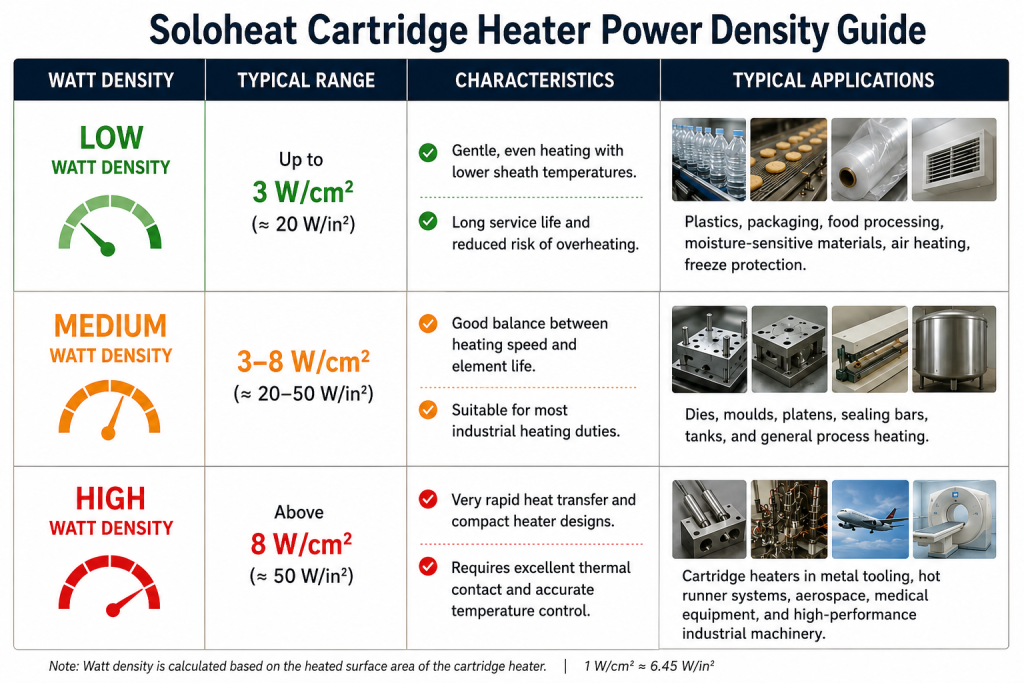
Two cartridge heaters of the same diameter can have very different power ratings. However, the total wattage alone does not tell you how heavily the heating element is being loaded.
Watt density describes the amount of electrical power being produced relative to the heated surface area of the cartridge heater and is normally expressed in W/cm².
As wattage increases within a given heater size, watt density also increases. A very short, high-powered cartridge heater may therefore operate under considerably greater thermal stress than a longer heater producing the same total wattage.
Why Higher Wattage Isn’t Always Better
Increasing heater wattage can reduce heat-up time, but only if the generated heat can be transferred effectively into the surrounding component.
If heat cannot dissipate quickly enough, the cartridge heater’s internal temperature can become unnecessarily high. This can increase thermal stress on the resistance winding, insulation and terminal area and may ultimately reduce heater life.
The objective should therefore be to provide sufficient power for the process without unnecessarily increasing the operating temperature of the heating element.
Heater Fit Is Important
Heat transfer is strongly influenced by the fit between a cartridge heater and its bore.
A correctly sized, accurately machined bore allows heat to conduct efficiently from the heater sheath into the surrounding metal. Excessive clearance creates an insulating air gap, reducing heat transfer and potentially causing the cartridge heater itself to operate at a much higher temperature.
For demanding or high-watt-density applications, heater diameter, bore tolerance and surface contact should therefore be considered alongside wattage.
What Determines the Required Cartridge Heater Wattage?
The principal factors include:
- Mass of the component – a larger mass generally requires more energy to achieve a given temperature rise.
- Material being heated – aluminium, steel, brass and other materials have different thermal characteristics.
- Temperature rise – heating from 20°C to 80°C requires considerably less energy than heating the same component to 300°C.
- Required heat-up time – faster heat-up normally requires greater available power.
- Heat losses – convection, radiation, conduction into surrounding machinery and process losses all increase the power requirement.
- Heater quantity and position – several correctly positioned heaters can often provide more even heating than concentrating the required power into a single heater.
- Operating cycle – continuous temperature maintenance and rapid cyclic heating can require quite different heater specifications.
Using Multiple Cartridge Heaters
Where space permits, distributing the required wattage between several cartridge heaters can provide more uniform heat distribution throughout a component.
For example, if an application requires approximately 2 kW of heating, four appropriately positioned 500 W heaters may provide better temperature uniformity than attempting to introduce the entire 2 kW through one small heating area.
The correct arrangement will depend on the geometry and thermal characteristics of the component.
Don’t Forget Temperature Control
Cartridge heaters should normally form part of a properly controlled heating system. A suitable temperature sensor and controller allow power to be regulated according to the actual process temperature rather than allowing the heater to operate continuously at full output.
Soloheat can supply Type J and Type K thermocouples, PT100 sensors and associated temperature-control equipment to suit industrial heating applications.
Need Help Calculating the Wattage?
For bespoke applications, Soloheat can help determine an appropriate cartridge heater specification.
Send us the component dimensions or drawing, material being heated, starting and required operating temperatures, required heat-up time, available heater diameter and length, supply voltage and any known process heat losses.
From this information we can advise on suitable heater wattage, watt density, quantity, dimensions and control arrangement.
🔧 Engineering Tip: The best cartridge heater is not necessarily the highest-wattage heater that will fit. Correct selection balances power, watt density, heat transfer, temperature control and heater life.
Soloheat Electric Heating Element Solutions – Quick Links
That’s some facts for thought, now take a look at our heating solutions:
- Cast Aluminium / Aluminium Bronze Heaters
- Ceramic Band Heaters
- Mica Band Heaters
- Cartridge Heaters
- Nozzle Heaters
- Spiral Wrap Heaters
- Thermocouples, Sensors, Plugs & Cables
- Tubular & Immersion Heaters
- Ancillary Items
- Insulation Jackets
- Heated Hoses
For more information on Electric Engineering Principles, check out our Engineering Guide